Cravvn
AI Restaurant Discovery
Year
2025
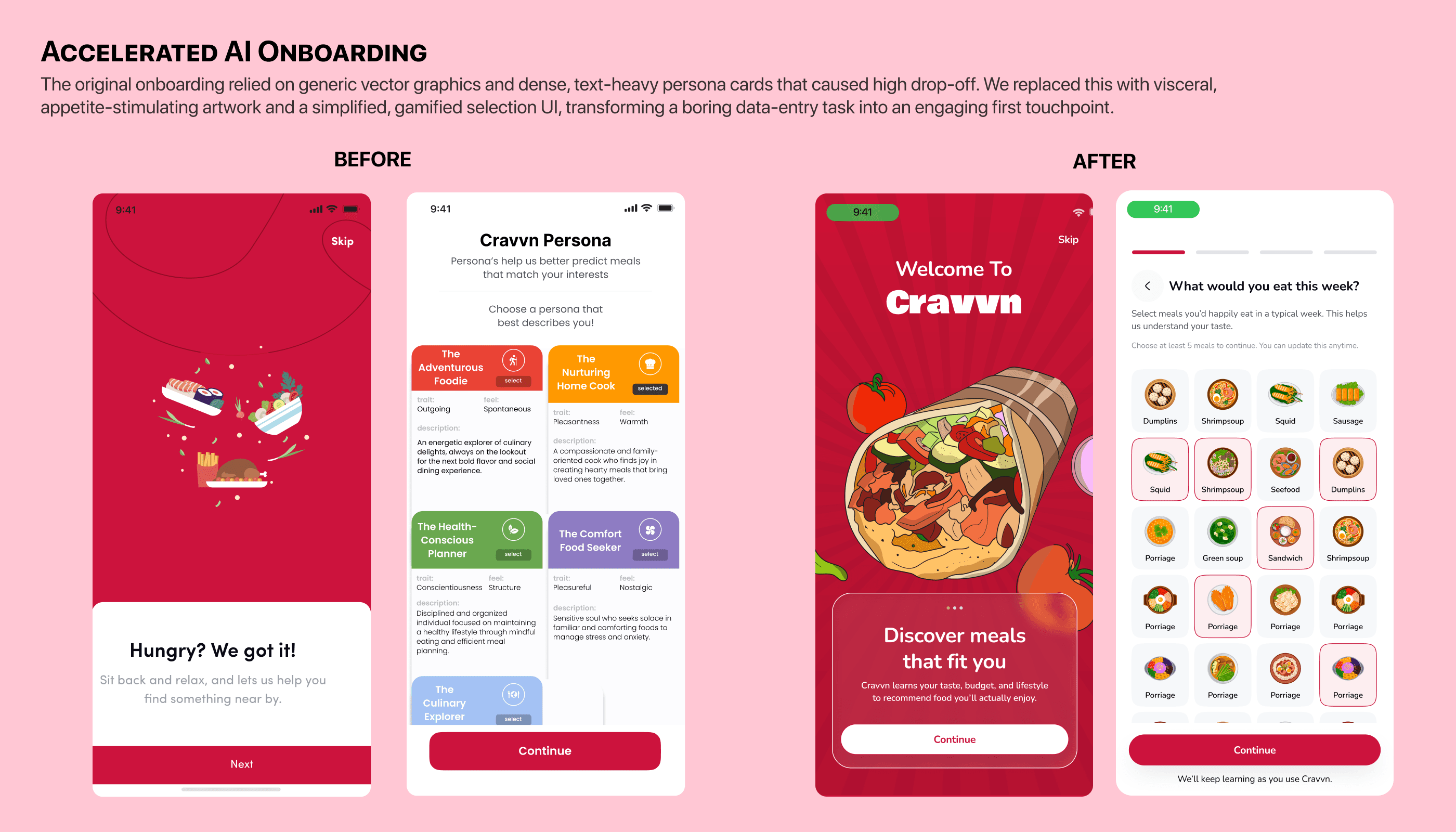
We redesigned Cravvn's onboarding to fix a hidden AI problem: the recommendation algorithm couldn't actually personalize because users were abandoning the intake flow before giving it enough data to work with.
Our solution turned data entry into a game and unlocked the AI's real potential.
The Problem — An AI That Couldn't Learn
Cravvn's MVP had a working AI recommendation engine. The problem wasn't the model, it was that nobody was feeding it.
New users were hitting the app and bouncing inside the first 90 seconds. The onboarding asked for dietary preferences, food habits, allergies, and crew information through dense, text-heavy forms. Day-one drop-off was catastrophic. The users who did make it through the intake gave minimal data, which meant the AI's recommendations felt generic, which meant users didn't return, which meant the AI never got enough signal to improve. A dead loop.
The business needed two things fixed simultaneously: stop the bleeding at onboarding, and build a retention mechanic that would drive users back daily.
The Solution — Tactile Personalization
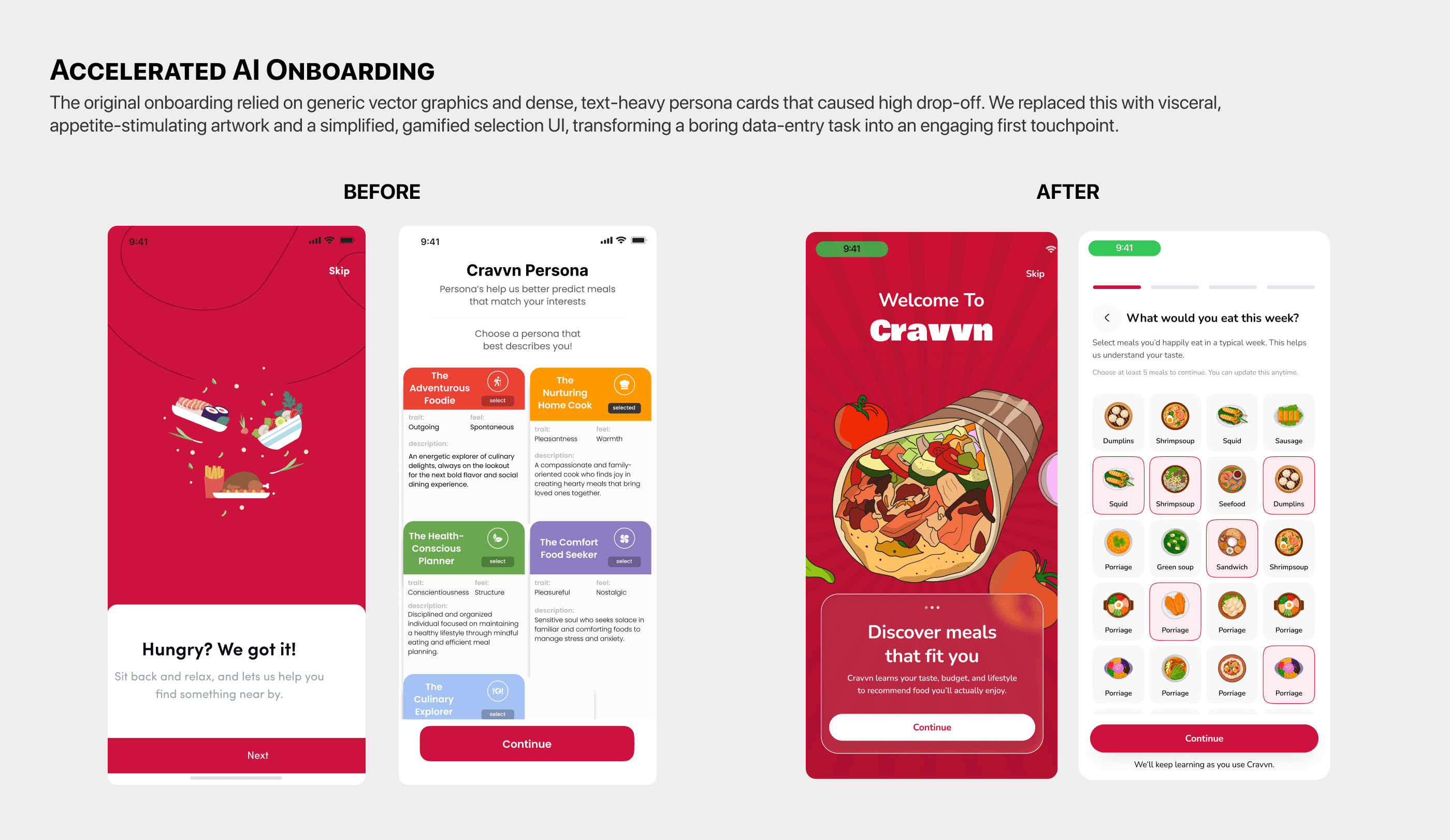
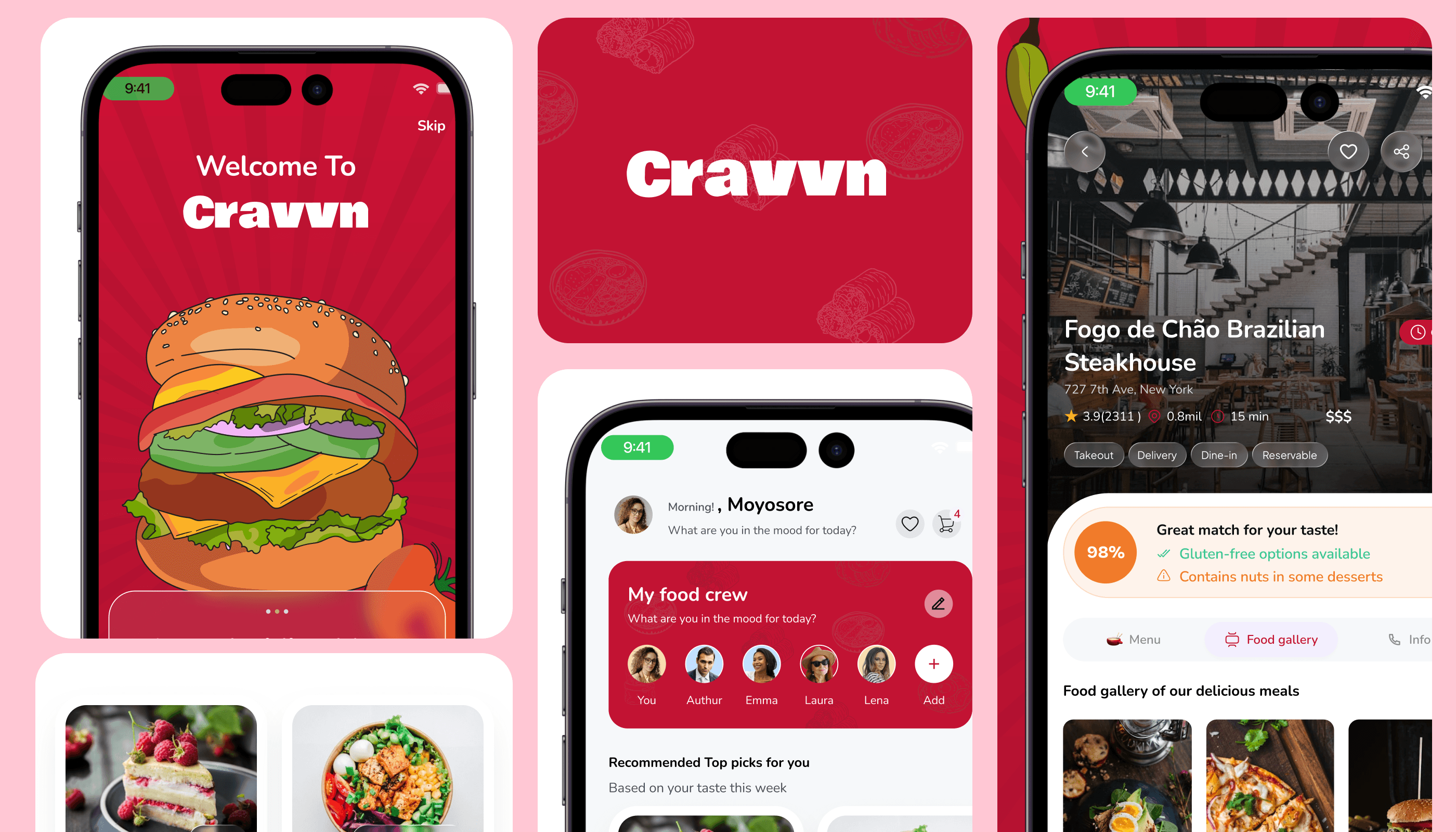
We stripped the legacy interface to the studs and rebuilt the intake as a gamified sequence. Instead of forms, users encountered persona cards, tactile illustrations, and appetite-forward visuals. Every interaction fed the AI training data but it felt like play, not work.
The psychology is deliberate: humans don't mind giving data when the input feels expressive. By reframing preference capture as a self-discovery ritual, we unlocked 4x the data depth per user while cutting completion time in half.
The Retention Layer — Food Crew
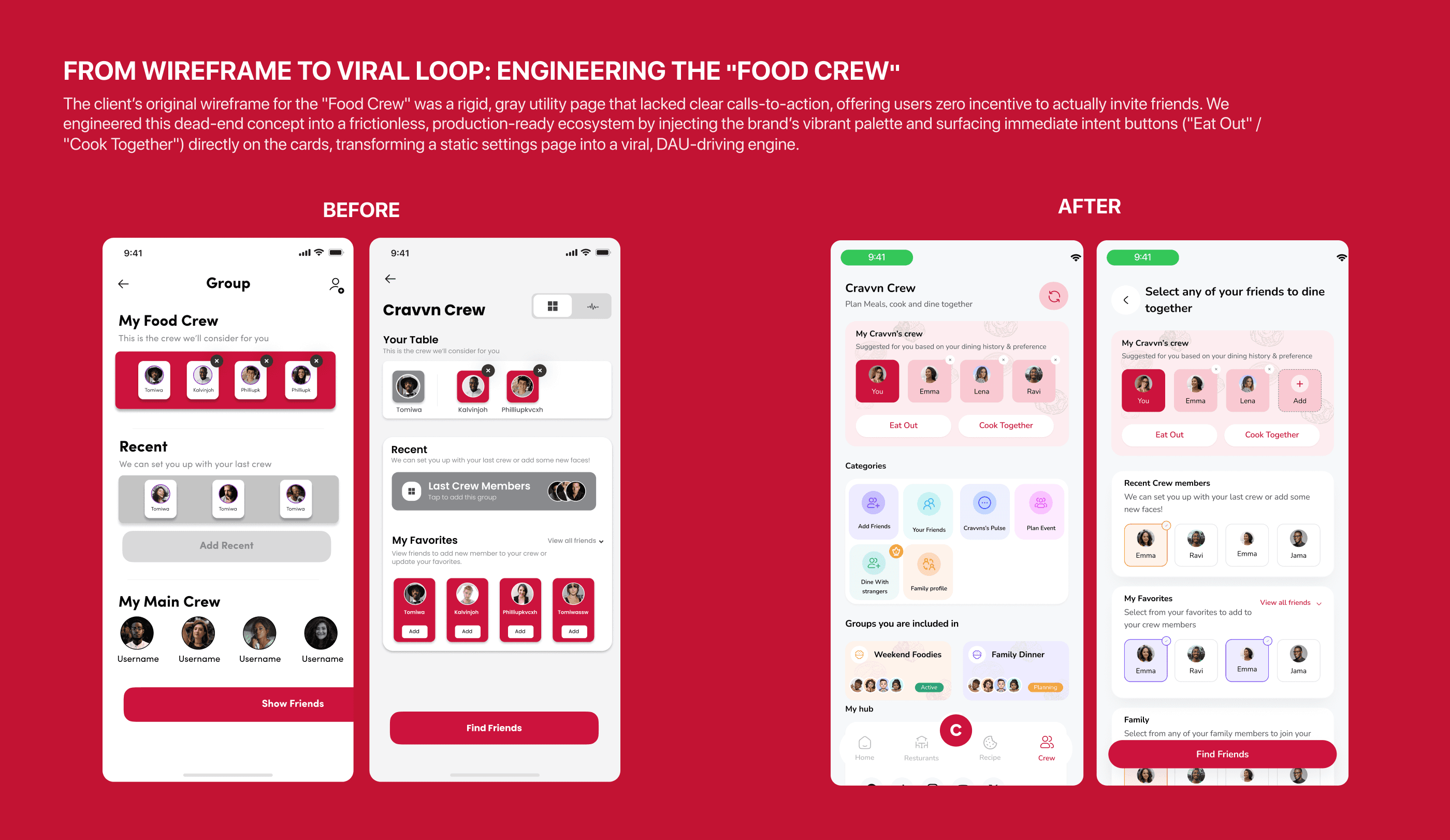
To solve long-term retention, we architected a social layer directly into the core navigation: the Food Crew.
Users sync taste profiles with friends, plan group meals, and trigger collective dining decisions through "Eat Out" and "Cook Together" CTAs. The original wireframe was a static settings page we rebuilt it as a viral DAU engine by surfacing intent-driven action buttons on every crew card and making invitation flows one-tap.
Making the AI Visible
An AI product only feels like AI if users can see it thinking. We designed two interfaces that expose the algorithm's reasoning:
The Taste Profile surfaces what the AI has learned — favorite cuisines as weighted tags, dining patterns, inferred dietary preferences so users feel understood rather than guessed at.
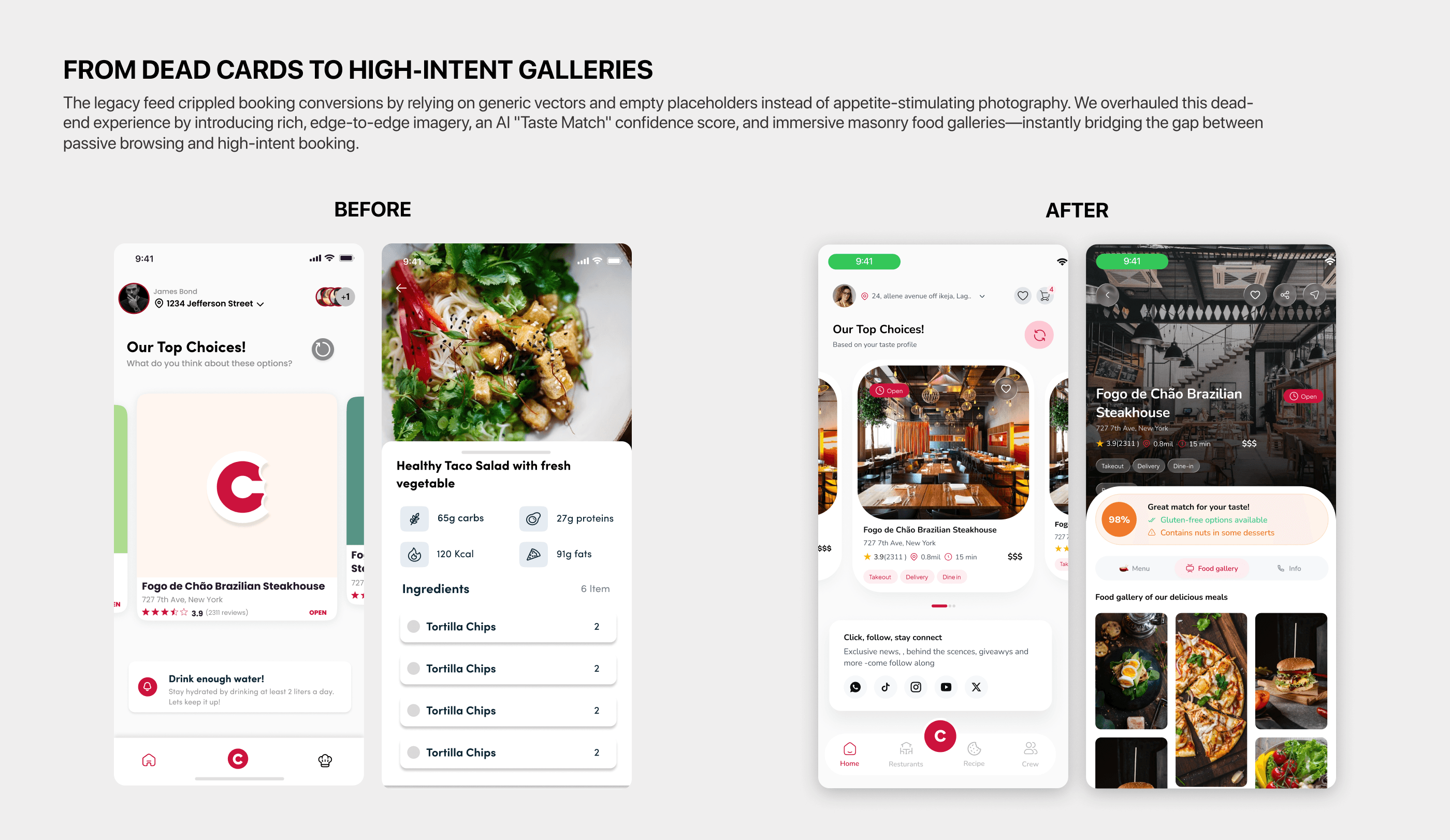
The "Why this?" drawer, triggered on any recommendation, reveals the AI's logic: "Based on your love for Italian + your crew's dietary restrictions + your recent ratings…". Transparency builds trust. Trust drives retention.
The Result
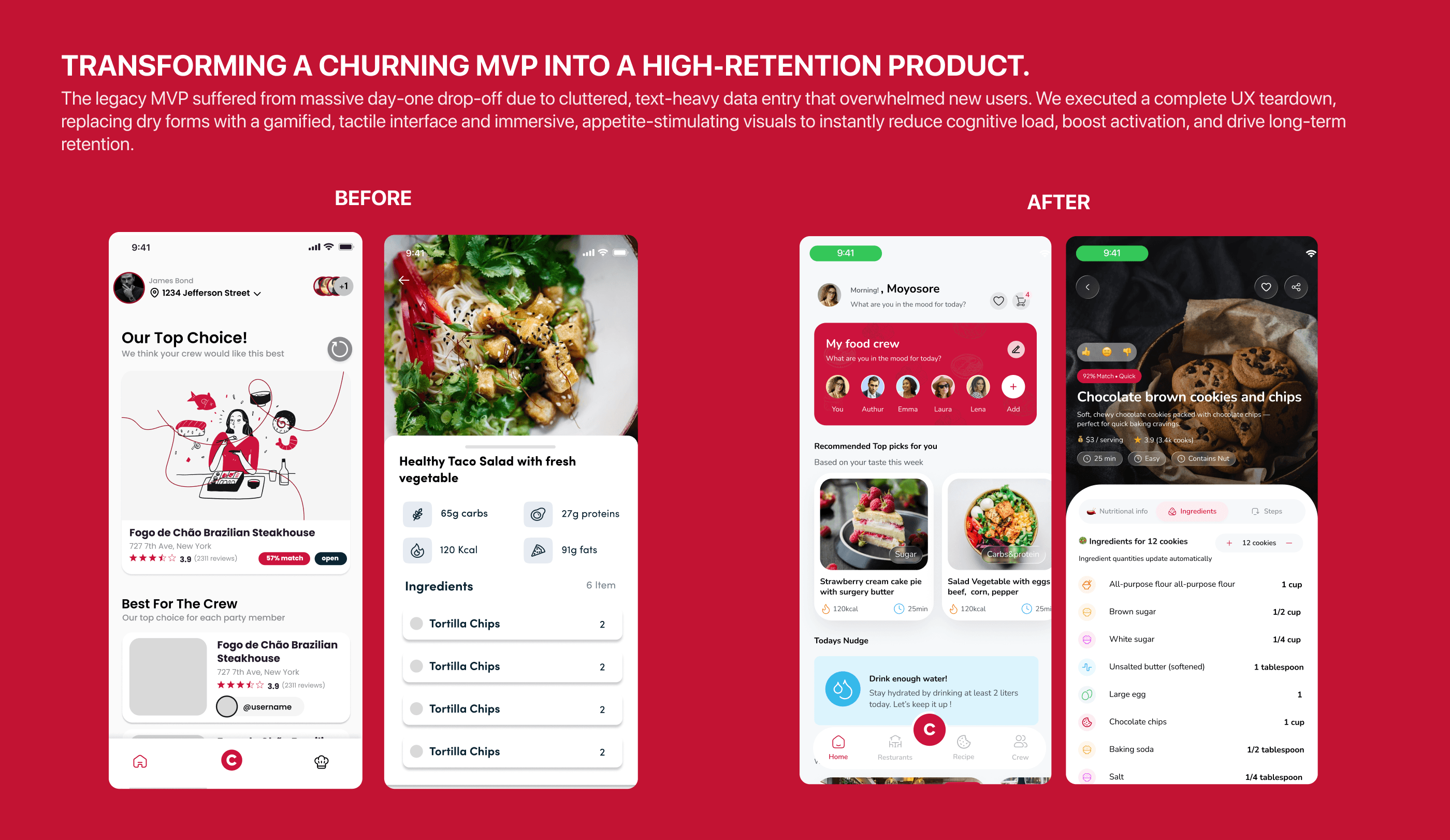
A churning MVP transformed into a high-retention AI product. Projected 35% drop in onboarding abandonment. 2x DAU through social virality. And most importantly an AI that finally had the data it needed to actually deliver on its promise.
We redesigned Cravvn's onboarding to fix a hidden AI problem: the recommendation algorithm couldn't actually personalize because users were abandoning the intake flow before giving it enough data to work with.
Our solution turned data entry into a game and unlocked the AI's real potential.
The Problem — An AI That Couldn't Learn
Cravvn's MVP had a working AI recommendation engine. The problem wasn't the model, it was that nobody was feeding it.
New users were hitting the app and bouncing inside the first 90 seconds. The onboarding asked for dietary preferences, food habits, allergies, and crew information through dense, text-heavy forms. Day-one drop-off was catastrophic. The users who did make it through the intake gave minimal data, which meant the AI's recommendations felt generic, which meant users didn't return, which meant the AI never got enough signal to improve. A dead loop.
The business needed two things fixed simultaneously: stop the bleeding at onboarding, and build a retention mechanic that would drive users back daily.
The Solution — Tactile Personalization
We stripped the legacy interface to the studs and rebuilt the intake as a gamified sequence. Instead of forms, users encountered persona cards, tactile illustrations, and appetite-forward visuals. Every interaction fed the AI training data but it felt like play, not work.
The psychology is deliberate: humans don't mind giving data when the input feels expressive. By reframing preference capture as a self-discovery ritual, we unlocked 4x the data depth per user while cutting completion time in half.
The Retention Layer — Food Crew
To solve long-term retention, we architected a social layer directly into the core navigation: the Food Crew.
Users sync taste profiles with friends, plan group meals, and trigger collective dining decisions through "Eat Out" and "Cook Together" CTAs. The original wireframe was a static settings page we rebuilt it as a viral DAU engine by surfacing intent-driven action buttons on every crew card and making invitation flows one-tap.
Making the AI Visible
An AI product only feels like AI if users can see it thinking. We designed two interfaces that expose the algorithm's reasoning:
The Taste Profile surfaces what the AI has learned — favorite cuisines as weighted tags, dining patterns, inferred dietary preferences so users feel understood rather than guessed at.
The "Why this?" drawer, triggered on any recommendation, reveals the AI's logic: "Based on your love for Italian + your crew's dietary restrictions + your recent ratings…". Transparency builds trust. Trust drives retention.
The Result
A churning MVP transformed into a high-retention AI product. Projected 35% drop in onboarding abandonment. 2x DAU through social virality. And most importantly an AI that finally had the data it needed to actually deliver on its promise.